Piha Kanahā
For 40 years, Puake‘ala Mann has kept the legacy of Kumu Hula Ma‘iki Aiu Lake alive at the Royal Hawaiian Center.
TEXT BY LINDSEY KESEL
IMAGES BY JOHN HOOK & COURTSEY OF STARGAZERS OF HAWAII 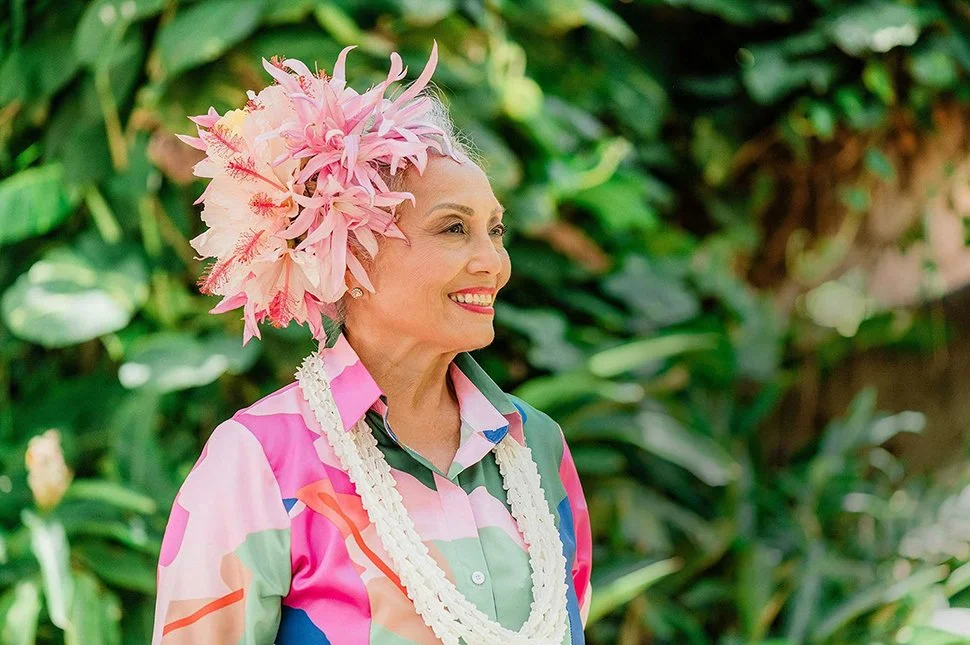

Puake‘ala Mann takes the stage at the Royal Grove, wāwae (feet) steady atop the well-worn wood. The mid-day sun shines brightly overhead, but Helumoa’s coconut trees afford the experienced kumu hula (hula teacher) with much welcome shade. Almost instantly, a crowd of haumāna (students) descends on the grassy knoll below her, like moths drawn toward Mann’s light.
“Aloha!” she speaks into the microphone, a gracious smile breaking across her face. She pronounces it with care, eschewing the improper extension of the “o,” a common misconception even among locals. From the very first word, the instruction has already begun. “We don’t scream it out. It’s a gentleness, when we speak ‘aloha,’’’ Mann later explains to me. “At the end [of the class], I say to them: ‘All my aloha to you. Mālama pono.’ Which means take good care, yes, but also make good choices in life.”
Weaving these insights throughout her weekly hula classes is critical. Whether teaching malihini (visitors) words of ‘ōlelo Hawai‘i or sharing beatitudes of wisdom, Mann’s every move follows in the footsteps of her beloved kumu hula: Ma‘iki Aiu Lake, the esteemed grand dame of hula and the first cultural director of the Royal Hawaiian Center.
Though hula studios were prevalent throughout the early 20th century, they prioritized hula ‘auana (modern hula), rarely training in hula kahiko (traditional hula). That is until Lake founded Hālau Hula O Ma‘iki in 1952, bringing a new rigor to the teaching of hula. She held regular classes for dancers of all types, no matter the age or skill level or background. And her hālau cultivated a deeper understanding of the artform. Students were required to research the meaning behind each chant and dance, rather than mere rote memorization of the movements.
“When I went to Aunty Ma‘iki’s [hālau], it was like I struck gold,” Mann says of her first lessons with Hālau Hula O Ma‘iki. She was 26 and wanted to “experience this life of learning, of culture.” The hālau satiated her yearning, nurturing in Mann a life-long reverence for hula and all its teachings. Mann would go on to enlist her daughters into the school, who in turn drafted their own children. Decades later, the hālau has become “a family thing,” says Mann of the three generations that now dance for the school.
Over the years, Lake became more than just a kumu to Mann. Her daughters grew up calling Lake Nana, and the ‘ohana (family) often went to the Lake home for holidays and birthdays. At times, she would substitute for Lake’s classes at the Royal Hawaiian Center. “It was just another thing that filled up my life, made it complete,” Mann says.
Upon Lake’s passing in 1984, Mann became the Center’s second cultural director. Though, even 40 years later, Mann insists that when she teaches, she is still merely substituting for her kumu. “I never thought that I was taking up her mantle,” she says, noting that she is merely a continuation of the legacy Lake leaves.
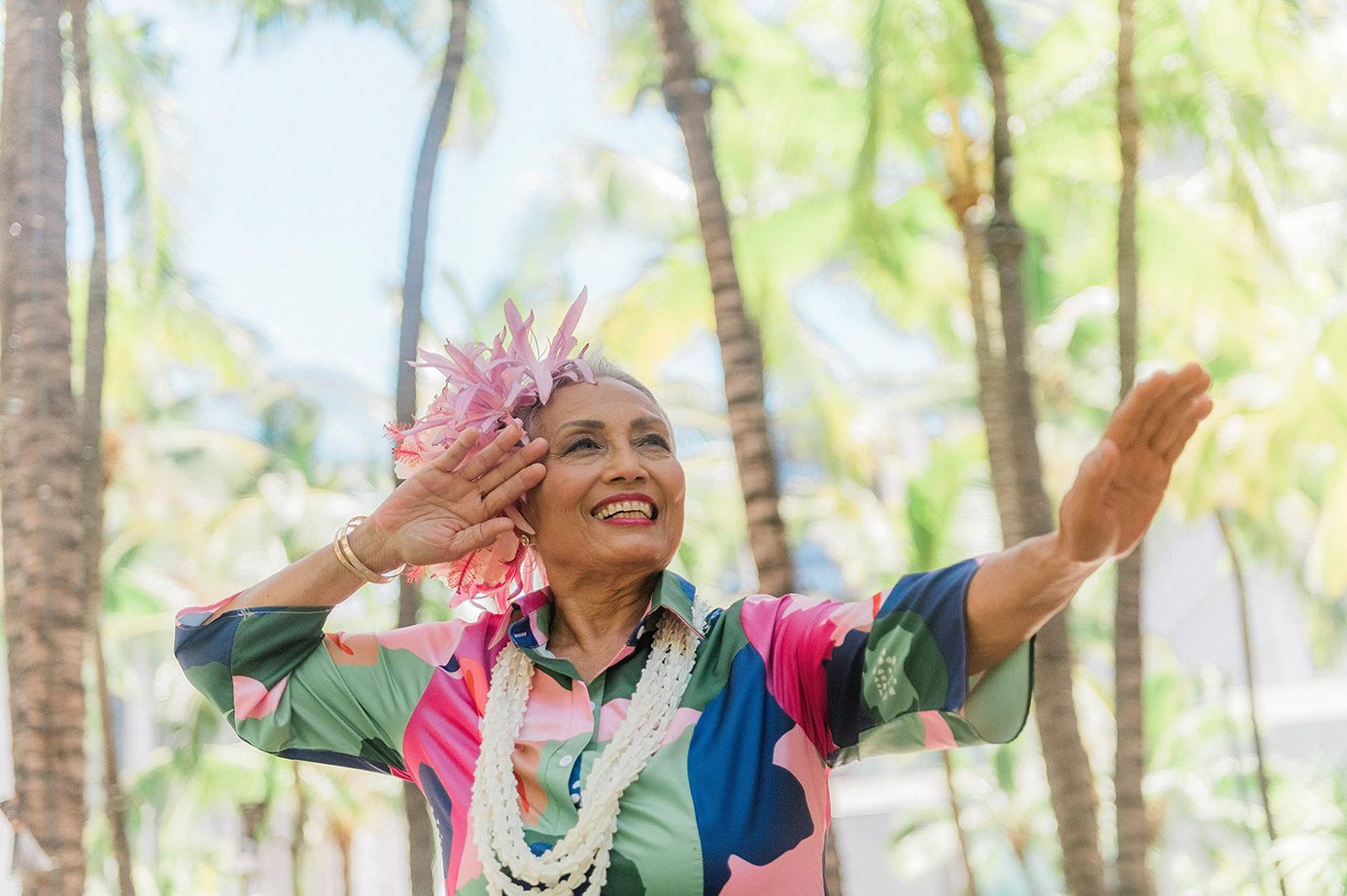
As the class winds down, Mann instructs her group of over two dozen students through one last verse. The mele “Henehene Kou ‘Aka” plays as Mann shows how to kaholo ‘akau (move right) and kaholo hema (move left). “Kuhi no ka lima, hele no ka maka—where your hands point is where your eyes should go,” she says, referencing a well-known ‘ōlelo no‘eau (proverb) among hula dancers.
Every word is a tactful reminder of the islands’ rich history and culture. For, much like the teachings of her kumu’s revered hālau, Mann wants these students to learn more than just the movements to a dance. “Hula is a way of life,” she says. “It is not just motions. When you reach out to someone, you are sharing a part of yourself. It’s a way of living. It’s everything that you’re able to share and to give.”